

The sitatunga is a unique, wetland-dwelling antelope found across sub-Saharan Africa. Adapted for life in the water, this elusive species was once believed by science to be extinct in Ghana. Here, its only population exists in the Avu Lagoon.
The sitatunga is classified as Least Concern globally, however, in West Africa, habitat loss and severe habitat fragmentation, as well as long-term changes to water levels, are all challenges for sitatunga. In Ghana, there is only one known population.
Sitatungas are wetland species, living in thickly vegetated swamps, marshes, and seasonally flooded forests. They rely on their wetland habitat for everything, from feeding and resting to escaping from predators.
Found across more than 25 African countries, sitatungas range from West Africa through Central and East Africa. In Ghana, the species exist only in the Avu Lagoon Community Protected Area – one of its most vulnerable populations.
Habitat loss resulting from bushfires, deforestation and expansion of farmlands into corezones combined with overhunting outside of protected areas is driving sitatunga decline in West Africa.
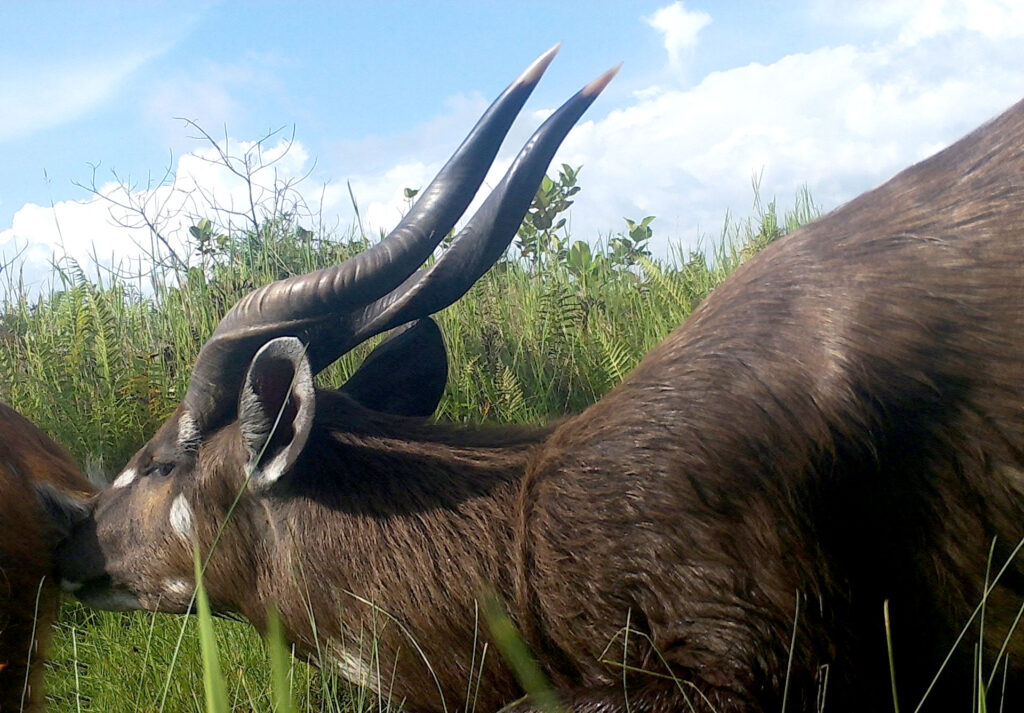
This semi-aquatic mammal is built for the wetland, and can be nearly invisible within it – they’re known to submerge completely underwater when threatened. They are one of Africa’s most specialized and unique antelope species.
The sitaunga is a medium-sized antelope; males are considerably larger than females, with long, twisting horns and a grayish-brown coat. Females are reddish-brown with no horns and white stripes. They have a shaggy, oily coat that serves as a waterproof layer to keep them warm in the water.
Sitatungas inhabit thickly vegetated swamps, marshes, and flooded forest across sub-Saharan Africa. They move through tunnelled pathways in tall reeds, rarely venturing onto firm ground. Because swamps provide a year-round food supply, sitatungas have small home ranges.
The sitatunga’s long, splayed hooves are one of its most distinctive features. Their hooves are well designed for muddy, vegetated swampland, but make this antelope clumsy and vulnerable on firm terrain. They are slow yet strong swimmers capable of covering several miles, using mounds of floating vegetation to take breaks.
The elusive sitatunga was long assumed extinct in Ghana by science, despite persisting locally and being well known as “tsimese.” Although never scientifically recorded in the country, its former presence had been inferred from populations in neighbouring Togo that disappeared by 1952, leading to its presumed extinction. In 1998, its continued presence at Avu Lagoon was confirmed through local hunters’ knowledge and the cultural practice of depositing sitatunga horns at hunting shrines.
This semi-aquatic antelope plays a role in maintaining the health of the wetlands. In Ghana, where the species exists in a single lagoon, its survival is also a measure of the health of one of West Africa’s freshwater wetlands, and losing it would mean the decline of this important ecosystem. Protecting the sitatunga and its critical habitat equally gives protection to a wide range of wildlife including birds, fish, monkeys, reptiles, rodents and insects within the ecosystem.
Sitatungas are easily caught by snares set along their regular pathways through the wetland, making hunting pressure a persistent threat outside of protected areas. In Ghana, habitat loss through wetland drainage, water quality due to agriculture encroachment, run-off from fertilizers and pesticides and long-term changes to water levels compound their risk, further fragmenting this already isolated population from breeding with others.
The Wilder Institute works with local communities and partners across the Avu Lagoon Community Protected Area to monitor and protect Ghana’s only sitatunga population. Strengthening the social-ecological resilience of the lagoon is an essential part of the Avu Lagoon Community Wetlands Program, because lasting conservation means improving livelihood security and natural resource governance for the communities at its centre.
We aim to maintain and grow Ghana’s only sitatunga population while building the regional knowledge needed to increase connectivity across West Africa’s other populations.
The Wilder Institute’s partnerships combine community governance, scientific expertise, and government support to protect both the sitatunga and the people who share their habitat.
The Wilder Institute aims to improve overall lagoon health by supporting ranger salaries, training, and equipment to strengthen wetland monitoring, collaborate on climate-smart agriculture projects to find ways to reduce the usage of fertilizers and pesticides, and protection of sitatunga’s habitat across the Avu Lagoon Community Protected Area.
Agreed conservation measures have an economic cost for the 17 communities of Ghana’s Avu Lagoon. We work with local partners to develop sustainable, ecologically sound livelihoods that help communities meaningfully engage with sitatunga’s conservation.
Explore the programs working to protect wetland species like the sitatunga and more.
The Wilder Institute collaborates with local communities and partners across the Avu Lagoon Community Protected Area to monitor and conserve Ghana’s only sitatunga population and the lagoon’s overall health. We also work to strengthen inclusive natural resource governance and build diversified livelihoods for the 17 communities whose farming and fishing activities are directly impacted by resource management measures. We support rangers with salaries, training, and equipment, while local trackers, remote cameras, and drones are building a knowledge base on sitatunga presence, habitat use, and behaviour. In addition, we are collaborating on wetland monitoring and climate-smart agriculture projects that will help develop practices to reduce agricultural encroachment of the Community Protected Area and reduce the use of pesticides/fertilizers.
The Avu Lagoon Community Protected Area in south east Ghana comprises a freshwater lagoon, seasonally flooded forests, grasslands and farmlands.
The sitatunga is found in wetlands across more than 25 African countries.
Support Ghana’s only known sitatunga population.
Your gift funds the community partnerships essential to protecting the Avu Lagoon population.
Explore monthly giving, corporate partnerships, and other ways to support conservation efforts.