

The curiously isolated hairstreak is a small grassland butterfly found in Western North America. There is a lot that we do not know about this species, so much of our work is about unravelling those mysteries.
The curiously isolated hairstreak exists in just one known population in Waterton Lakes National Park. Its extremely restricted range means one major event could wipe it out entirely. Vulnerable to wildfire and habitat disturbance, this species is at significant risk.
This butterfly depends on the native grassland habitat within the Blakiston Fan of Waterton Lakes National Park. It relies on healthy populations of silvery lupine, native flowering plants, and ecological conditions that support its specialized relationship with local ant species.
The curiously isolated hairstreak is found only in southwestern Alberta within Waterton Lakes National Park. Its entire global range covers approximately 300 hectares on the Blakiston Fan, making Canada solely responsible for protecting this unique species and its habitat.
Wildfire, invasive plants, and habitat disturbance threaten the species’ only known population.
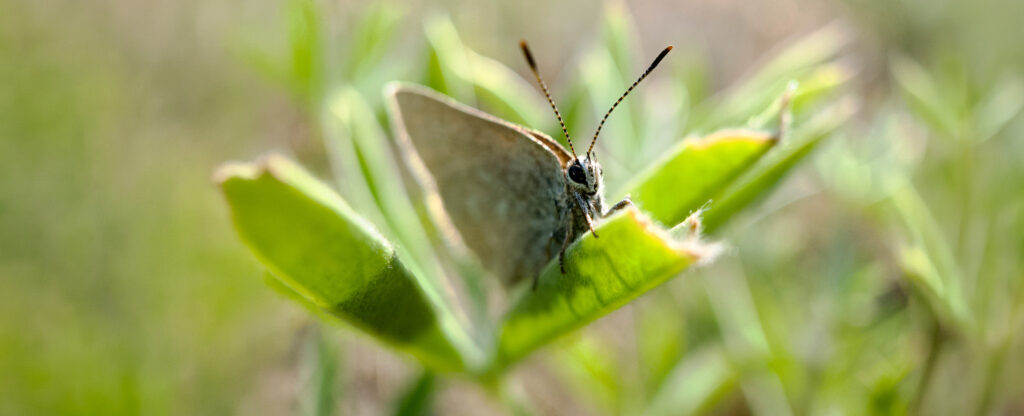
For thousands of years, this tiny butterfly evolved in isolation within Alberta’s grasslands, forming a distinct species found nowhere else on Earth. It is deeply connected to the ecological health of Waterton Lakes National Park.
The curiously isolated hairstreak is a small grassland butterfly identified as its own species following genomic and ecological studies. Previously believed to be part of the widespread half-moon hairstreak, researchers discovered that it has been isolated from related populations for roughly 40,000 years, following its own evolutionary trajectory.
This butterfly species exists only on the Blakiston Fan in Waterton Lakes National Park, Alberta. This windswept grassland ecosystem supports the silvery lupine plants and other ecological relationships that the butterfly depends on, making the protection of this landscape essential to the species’ future.
With a wingspan roughly the size of a quarter, the curiously isolated hairstreak is small and well camouflaged within the grasslands. Its colouring helps it blend into surrounding vegetation, often making it difficult to notice until it’s perched on bright yellow buckwheat flowers.
The curiously isolated hairstreak has a mutualistic relationship with a specific ant species called Lasius ponderosae, a pairing not seen in other hairstreak populations. The butterfly larvae will secrete a sugary substance that will attract and feed the ant and in return, the ant will protect the larvae from other predators. This unique relationship helped confirm the butterfly as a separate species.
As a pollinator, this butterfly contributes to the health and resilience of native grassland ecosystems. Protecting this species safeguards the important ecological relationship between plants, insects, and wildlife within one of Canada’s most ecologically diverse landscapes. With its unique, irreplaceable lineage, losing the curiously isolated hairstreak would mean the disappearance of an entire species.
Because the curiously isolated hairstreak exists only in one location, even a single event could threaten the entire species. The 2017 Kenow wildfire destroyed more than half of its habitat, contributing to significant population decline. Invasive plants, habitat degradation, and increasing environmental pressures continue to place this isolated butterfly at risk.
The Wilder Institute works with Parks Canada and research partners to better understand and protect the curiously isolated hairstreak through field monitoring, ecological research, habitat assessments, and conservation planning. This work helps guide evidence-based recovery efforts while exploring long-term solutions that reduce extinction risk.
Given the species’ vulnerability, researchers are exploring the feasibility of conservation breeding. Early work had successfully encouraged egg laying under controlled conditions and collected key information about larval development, host plants, and survival. This research is building the evidence base needed to consider future conservation breeding or translocation.
Because the species exists in only one location, establishing a second population is an important long-term goal. Working with Parks Canada, we are evaluating potential sites within or near the park that could support reintroductions.
Working with Parks Canada, the Wilder Institute helps identify priority areas for invasive plant removal and habitat restoration. This helps improve conditions of silvery lupine and other native grassland species that the curiously isolated hairstreak depends on.
Waterton Lakes National Park is an ecological and cultural landmark. Conserving the curiously isolated hairstreak helps maintain the biodiversity that makes the park globally recognized as an International Peace Park, UNESCO Biosphere Reserve, World Heritage Site, and International Dark Sky Park. The program also supports training and research opportunities for graduate students and early career conservationists.
Our collaborative conservation programs are helping protect pollinators and other native grassland species.
Since 2019, the Wilder Institute has partnered with Parks Canada to research, monitor, and develop a long-term conservation strategy for the curiously isolated hairstreak. Our work spans genomic research, ecological fieldwork, habitat restoration support, and feasibility studies for conservation breeding. There is still so much to uncover about this species, including building the evidence needed to understand how to protect it.
This program is centred on the Blakiston Fan within Waterton Lakes National Park – a UNESCO Biosphere Reserve, World Heritage Site, International Peace Park, and International Dark Sky Park. Field surveys, habitat assessments, and ecological research are conducted within this small area. Work to evaluate potential sites for a second population is also underway in and around the park.
✓
Successfully collected wild eggs to raise in human care
4
Four peer-reviewed papers based on the program, more on the way.
>12
Over a dozen volunteer spotted knapweed pulls organized to help reduce invasive species pressure on habitat.
This species exists only within one small grassland area in Alberta.
Support conservation efforts that protect isolated, vulnerable species and fragile ecosystems.
Your support helps fund research, habitat restoration, and long-term recovery planning for species at risk.
Help strengthen conservation through advocacy, learning opportunities, and support for evidence-based wildlife recovery.
Discover additional ways to make an impact through monthly giving, corporate partnerships, and community fundraising.